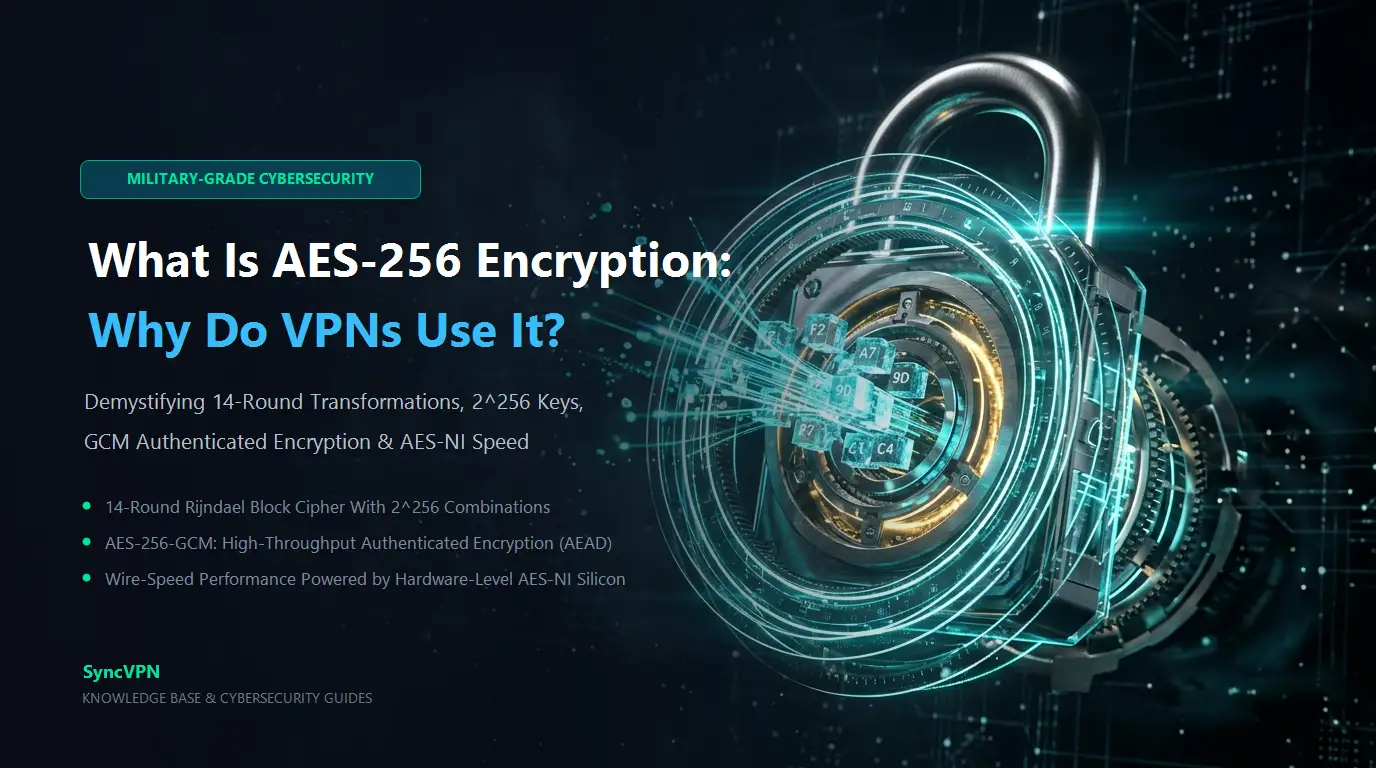
AES-256 encryption is a military-grade cryptographic cipher that scrambles digital data using a 256-bit key, making it mathematically impossible to decrypt through brute-force attacks with modern computing power. Virtual Private Networks rely on AES-256 to shield internet traffic from ISP surveillance, government interception, and malicious packet sniffers, transforming sensitive communications into unbreakable ciphertext before they leave your device.
Whenever you browse the web on public Wi-Fi, conduct online banking transactions, or connect to confidential enterprise infrastructure, your network packets traverse dozens of intermediate switches and routers. Without robust cryptographic encapsulation, every URL you visit and every unencrypted credential you submit remains visible to third parties. Understanding how AES-256 works, why it represents the undisputed gold standard in cybersecurity, and how modern VPN architectures implement it without degrading internet performance is essential for evaluating your digital privacy.
The Mathematics of Unbreakability: How AES-256 Works
The Advanced Encryption Standard (AES) was established in 2001 by the U.S. National Institute of Standards and Technology (NIST) to replace the aging Data Encryption Standard (DES). Selected through a transparent five-year cryptographic competition, the underlying Rijndael cipher was engineered by Belgian cryptographers Vincent Rijmen and Joan Daemen.
AES is a symmetric key block cipher. "Symmetric" means that the same cryptographic key is utilized to encrypt data into ciphertext and decrypt it back into plaintext. "Block cipher" indicates that rather than encrypting data bit by bit, AES groups unencrypted data into fixed blocks of 128 bits (16 bytes).
The 14 Rounds of Transformation
To transform legible plaintext into indecipherable noise, AES-256 subjects every 128-bit block to 14 sequential rounds of mathematical permutation. While AES-128 uses 10 rounds and AES-192 uses 12 rounds, AES-256 executes the maximum 14 rounds, providing an extraordinary security buffer. Each round consists of four distinct cryptographic operations:
SubBytes: A non-linear substitution phase where each byte is replaced with another byte according to a pre-defined cryptographic lookup matrix (S-box), preventing direct mathematical correlation.
ShiftRows: A transposition step where the rows of the 4x4 state array are cyclically shifted by specific offsets, dispersing data across columns.
MixColumns: A linear transformation that mixes the four bytes of each column using modular matrix multiplication, ensuring high diffusion across the block.
AddRoundKey: The state block is combined with a unique round subkey derived from the master 256-bit key using a bitwise XOR operation.
This multi-round design produces an avalanche effect: altering a single bit in the original plaintext changes more than 50% of the resulting ciphertext bits, completely concealing structural patterns.
Why Brute-Force Attacks Are Physically Impossible
A 256-bit key allows for 2^256 unique key combinations, equivalent to approximately 1.1579 x 10^77 possibilities. To grasp the scale of this number:
Metric | Scientific Scale | Real-World Context |
|---|---|---|
Estimated Atoms in the Observable Universe | ~10^80 | Fundamental physical particles in existence |
AES-256 Key Combinations | ~1.15 x 10^77 | Total cryptographic combinations to guess |
Top 500 Supercomputers Combined Output | ~10^18 operations/sec | Cumulative global high-performance compute |
Time Required to Brute-Force AES-256 | Billions of Years | Exceeds the projected lifespan of our solar system |
Even if every computer on Earth were repurposed into a unified supercluster capable of calculating billions of keys per second, testing a decisive fraction of the AES-256 keyspace would require more energy than the sun will produce in its entire lifetime.
Why VPNs Depend on AES-256 for Tunnel Security
A Virtual Private Network creates a protected communications pathway across an insecure public network. AES-256 functions as the mathematical vault surrounding the data traveling through this pathway.
1. Neutralizing ISP Telemetry and Packet Inspection
Internet Service Providers routinely track user traffic patterns, logging visited domain names, unencrypted data payloads, and session lengths. Many providers deploy Deep Packet Inspection (DPI) to monitor user activities, throttle high-bandwidth connections, or monetize aggregate browsing profiles.
When your device routes internet traffic through a provider like SyncVPN, AES-256 encrypts your data payload before it reaches the local network interface. Your ISP only sees an encrypted data stream traveling between your router and a secure VPN server node. The websites you open, files you transfer, and queries you resolve remain unreadable.
2. Eliminating Man-in-the-Middle Attacks on Public Wi-Fi
Public Wi-Fi networks in airports, hotels, and cafes often lack basic client isolation, exposing users to evil-twin hotspots, ARP spoofing, and packet interception. Cybercriminals on the same local subnet can capture broadcast packets to harvest session cookies and authentication tokens. Encapsulating all outgoing packets inside an AES-256 tunnel renders intercepted packets meaningless, neutralizing eavesdropping attempts on untrusted networks.
3. Preserving Forward Secrecy
Elite VPN deployments combine AES-256 symmetric encryption with ephemeral key exchange mechanisms like Diffie-Hellman or Elliptic Curve cryptography (ECDH). This architecture establishes Perfect Forward Secrecy (PFS), which generates a completely new, temporary symmetric session key every few minutes or every time you disconnect. Even in the theoretical scenario where a session key is intercepted, past and future browsing sessions remain encrypted and unreadable.
AES-256-GCM vs. AES-256-CBC: Why Cipher Mode Matters
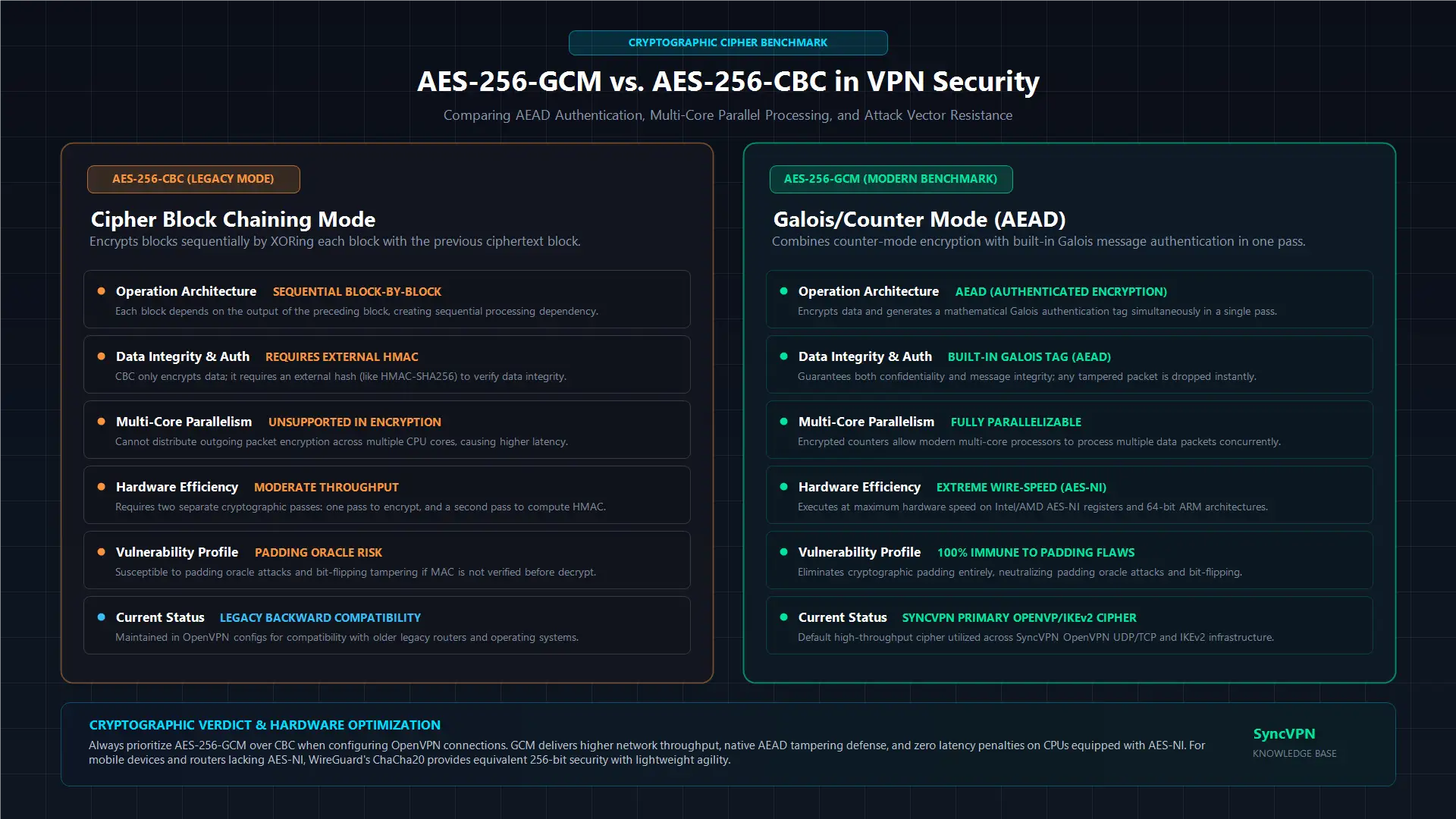
Saying a VPN uses "AES-256" is only half the equation. The operational mode dictates how the cipher handles multiple blocks of data and verifies packet authenticity. The two most prominent modes in VPN engineering are CBC and GCM.
Architectural Feature | AES-256-CBC (Cipher Block Chaining) | AES-256-GCM (Galois/Counter Mode) |
|---|---|---|
Operation Type | Encryption only (requires separate HMAC) | Authenticated Encryption (AEAD built-in) |
Parallel Processing | Sequential only (slower on multi-core CPUs) | Fully parallelizable (maximum throughput) |
Computational Speed | Moderate | Extremely Fast |
Integrity Verification | Needs external hash (e.g., HMAC-SHA256) | Built-in Galois authentication tag |
Vulnerability Profile | Vulnerable to padding oracle attacks if misconfigured | Immune to padding-based exploits |
Industry Recommendation | Legacy standard | Modern industry benchmark |
In AES-CBC mode, each block of plaintext is XORed with the preceding ciphertext block before encryption. CBC does not authenticate data integrity natively; it requires a secondary cryptographic hash (such as HMAC-SHA256) to ensure the packet has not been altered in transit.
Modern protocols favor AES-256-GCM because it provides Authenticated Encryption with Associated Data (AEAD). GCM encrypts data using a counter mechanism while simultaneously generating an authentication tag using Galois field multiplication. Because GCM allows multiple data blocks to be processed simultaneously across modern CPU cores, it delivers substantially higher throughput and lower latency while eliminating padding oracle attack vectors.
Does AES-256 Slow Down Your Internet? The Role of AES-NI
A common misconception is that running intensive 14-round encryption must bottleneck your broadband speeds. While cryptographic overhead does add microscopic processing delays, modern hardware has virtually eliminated this penalty through specialized instruction sets.
Leading CPU manufacturers incorporate dedicated hardware acceleration directly into silicon:
Intel and AMD processors feature AES-NI (AES New Instructions), which executes complex AES operations at the hardware register level rather than via software emulation.
Modern ARM architectures (powering Apple Silicon, Android smartphones, and modern routers) include the ARM Cryptography Extensions, providing dedicated hardware acceleration for cryptographic workloads.
Because modern devices process AES-256 at wire speed, any perceived slowdown when using a VPN rarely stems from cipher computations. Speed variations are almost exclusively driven by physical distance to the server, ISP routing congestion, or local Wi-Fi latency rather than AES encryption.
AES-256 vs. ChaCha20: The Modern Protocol Landscape
While AES-256 remains the cornerstone of OpenVPN and IKEv2/IPsec protocols, newer protocols like WireGuard implement ChaCha20-Poly1305. Understanding how these ciphers compare clarifies why modern VPN providers offer both.
ChaCha20 is a 256-bit stream cipher designed by Daniel J. Bernstein. It operates on 512-bit state arrays and is paired with Poly1305 for cryptographic authentication.
On Desktop CPUs and Flagship Smartphones: Processors equipped with AES-NI hardware acceleration process AES-256 and ChaCha20 at virtually identical, blazing speeds.
On Budget Hardware and Low-Power Routers: Processors lacking hardware-level AES-NI often experience performance degradation when processing AES-256 in software. ChaCha20 was explicitly engineered to deliver lightning-fast performance across general-purpose CPU registers without requiring dedicated cryptographic hardware instructions.
Both ciphers deliver uncompromised 256-bit cryptographic strength. Advanced providers maintain a multi-protocol infrastructure, enabling users to leverage AES-256 through OpenVPN or utilize ChaCha20 via WireGuard based on specific hardware and routing requirements.
Is AES-256 Safe Against Quantum Computers?

Quantum computing introduces algorithms capable of disrupting traditional asymmetric public-key cryptography (such as RSA and Diffie-Hellman) by solving discrete logarithm and prime factorization problems via Shor's Algorithm.
Symmetric ciphers like AES-256 face a different quantum mechanism known as Grover's Algorithm. Grover's algorithm provides a quadratic speedup for unstructured database searches, effectively halving the mathematical security of a symmetric key:
An AES-128 key subjected to Grover's algorithm drops to an effective strength of 64 bits, placing it within theoretical reach of future fault-tolerant quantum computers.
An AES-256 key subjected to Grover's algorithm is reduced to an effective post-quantum security level of 128 bits.
Because a 128-bit keyspace still requires 2^128 operations to brute-force—a computational barrier far exceeding any physical machine conceivable under the laws of quantum thermodynamics—AES-256 is formally classified as quantum-resistant. Long after legacy public-key infrastructure has transitioned to post-quantum standards, AES-256 will remain computationally unbreakable.
Summary and Key Takeaways
AES-256 is a symmetric block cipher that processes data in 128-bit blocks through 14 mathematical rounds using a 256-bit key.
Brute-forcing an AES-256 key would take billions of years using all combined supercomputers on Earth, making it the globally accepted gold standard for government and financial security.
AES-256-GCM is the modern standard for VPNs, delivering authenticated encryption with higher throughput and lower CPU overhead compared to legacy CBC modes.
Modern processors utilize AES-NI and ARM crypto extensions to process AES-256 at hardware wire speeds, ensuring zero noticeable impact on broadband performance.
While WireGuard deploys ChaCha20 for lightweight hardware agility, AES-256 remains the proven, time-tested foundation across enterprise OpenVPN and IKEv2 network infrastructure.